The Bren machine gun was manufactured by the Royal Arms Factory based on an earlier Czech light machine gun design. The Bren gun was used by British Commonwealth forces in World War II, the Korean War, Suez Crisis, Falklands War, the Gulf war, and many other conflicts since World War II. The Bren LMG is still manufactured in India.
The 7.62 mm Ruchnoy Pulemyot Degtyaryova pakhotnyi ("Degtyarev Hand-held Infantry Machine Gun") was a paragon of simplicity and easy maintenance. Apart from a bipod which was prone to break if handled roughly, the DP-28 provided the Red Army with reliable and effective fire from its introduction in 1928 to the end of the War.
The Fallschirmjägergewehr 42, abbreviated to "FG42", is an assault rifle used in Call of Duty, Call of Duty: United Offensive, Call of Duty 3, and Call of Duty: World at War. In Call of Duty and United Offensive, the weapon is only available when scoped. In Call of Duty 3, scoped and non-scoped variants are available.
FlaK 88 mm gun was a German anti-aircraft and anti-tank artillery gun used during World War II. The FlaK 36 is featured in many of the Call of Duty games. It is often called the Flak 88 by mistake, the correct designation of these guns was Flak 36.
The Flakvierling is an anti-aircraft weapon that fires the 20x128mm cartridge. Based upon the idea of putting four 2 cm Flak 30 guns onto one mount, the Flakvierling was a very successful anti-aircraft gun used throughout WWII by the Germans.
The German Flammenwerfer 35 uses compressed nitrogen to propel flaming liquid fuel as far as 33 yards. Though Flammenwerfer teams were extremely vulnerable in the field and had to be well-protected from enemy fire, the weapon was devastatingly effective, especially when used for flushing out infantry from bunker or entrenchment.
Gewehr 43 (pronounced Guh-vier) was a semi-automatic rifle used by the German soldiers during World War II. The Gewehr 43 fires the powerful 7.92x57mm Mauser round from a 10-round detachable box magazine.
The Mauser Karabiner 98 Kurz (commonly abbreviated "Kar98k") was the Wehrmacht's standard issue infantry rifle during World War II. It was introduced in 1935 and incorporates the classic Mauser bolt action design. It holds five rounds of 7.92x57mm ammunition (also known as 8mm Mauser) in an internal magazine fed by a five round stripper clip.
The Karabiner 98k is the carbine version of the Gewehr 98[1]. The Karabiner 98k was used on all fronts in World War II, and still even sees service in third-world conflicts; some have been found in use by insurgents in the Iraq War.
The Lee-Enfield is a bolt-action rifle and was the standard rifle for the British Armed Forces from 1895 to 1957. The rifle used during World War II was the No 4 model, distinguished by its use of an aperture sight as opposed to an open sight. The Lee-Enfield rifle was a famously effective arm, primarily due to its rear locking bolt. This reduced accuracy slightly, but allowed the bolt to be operated quickly and easily. A skilled rifleman using a Lee-Enfield could fire off at least twenty or thirty well-aimed shots in a minute(also known as the Mad Minute). The world record is 38 shots in a minute. A popular motto for the rifle was "Ten shots in ten seconds". The British exploited this advantage to the fullest to the point where during World War I, massed rifle fire was mistaken by the Germans for machine-gun fire! The rifle was replaced in 1957 by the L1A1, a variant of the Belgian FN FAL. The weapon was also used by the mujahideen during the Soviet war in Afghanistan. Lee-Enfields are still produced today in the Khyber Pass region because in desert and mountain environments long range accuracy is often favored over rate of fire.
The Luger P08 or the Luger pistol was a German semi-automatic self-loading pistol used during World War I and World War II.
The M1 Garand is a semi-automatic, gas-operated service rifle that was used by the United States during World War II, Korea, and to limited extent, Vietnam.
The Thompson submachine gun or the "Tommy Gun" was a sub-machine gun used by the Allies during World War II
The M1911A1 is an American single-action, .45 caliber semi-automatic handgun designed by John Moses Browning. It was adopted by the military after being tested, and was used for over 90 years until it was largely replaced by the M9. However, special operations still use Kimber and Springfield Armory 1911A1s. The M1911 has been used in almost every major conflict in the 20th and 21st century, and its reliability has made it one of the most common pistols in the world. Many modern handguns are based the M1911's tilting barrel short recoil system. Colt still produces the same design that was used during WWI. Now, dozens of mainstream manufacturers produce several variants in every major caliber.
The Browning Automatic Rifle, or the "B.A.R.", was an American Support weapon used during World War I, World War II, the Korean War and the Vietnam War.
The M1919 Browning medium machine gun was an air cooled machine gun designed by John Browning. Intended as a supplement for the heavier, water cooled M1917, it served as a general purpose machine gun being used everywhere from aircraft to infantry. The M1919A4 was the most used variant. Later, the M1919A6 was introduced and was generally disliked. It often had the in-line stock cut off to reduce weight.
The M2 Browning machine gun is a .50 Caliber version of the M1917 .30 Caliber Browning Machine gun.[1] Also known as "The Browning .50 Cal" and "Ma Duce", it was designed to fire the Winchester .50 BMG, developed in response to the 13MM Anti-Tank Rifle used by Germany. While originally designed as an Anti-Tank weapon, the M2 Browning has had a variety of roles in its more than 80 years of service. It has seen action in almost all conflicts Post-WW1, from WWII to Operation Iraqi Freedom. The most common use today for the M2 is as an anti-aircraft mount on the Command Copula of Armored Vehicles, such as the M1A2 Abrams Main Battle Tank. It is also used by a variety of NATO and non-NATO countries, such as Canada, the United Kingdom, Japan, Israel, South Korea, Switzerland and many others.
The MG34, or Machinengewehr 34, was a German machine gun fielded in 1934. Though the Treaty of Versailles specifically prohibited Germany from producing any kind of sustained-fire weapon, they circumvented this by funding its development in Switzerland. This development produced an aircraft machine gun, the Rheinmetall MG15, from which the MG 34 was born. Considered one of the finest machine gun designs in history, the MG34 saw service on all fronts of the war often found en masse with the MG42 as well.
The MG42 (Maschinengewehr 42: Machine gun 42) was a machine gun used by the Wehrmacht against the Allies during World War II
Known to American GIs as the "Schmeisser" or "burp gun", the MP-40 (MP designates Maschinenpistole 40, literally "Machine Pistol 1940") is a sub-machine gun developed in Nazi Germany and used extensively by paratroopers, platoon and squad leaders, and other troops during World War II. The MP-40 was characterized by its relatively low rate of fire and recoil.
The Mills Bomb is the standard British grenade used throughout World War II, but was adopted into the British Army during World War I.
The Mk 2 grenade was a fragmentation hand grenade commonly used by the Americans during World War II. It is seen throughout all the WWII-themed Call of Duty games.
The Mosin-Nagant series of rifles were the standard issue Soviet bolt-action rifles during World War II. They are chambered in 7.62x54mmR and have a five round internal magazine loaded via stripper clips. Mosin-Nagants are seen in all Call of Duty games featuring Soviet troops. A scoped version is available in some situations. Due to the placement of the scope, it is impossible to reload a scoped Mosin-Nagant with a stripper clip in real life, but its reload animation in Call of Duty and Call of Duty: United Offensive show a stripper clip being used anyway. In reality, each round would have to be loaded individually. It isn't until Call of Duty: Finest Hour that you load the rounds individually in the chamber.
The PPSh-41, officially designated the "Пистолет-пулемёт Шпагина" ("Pistolet-Pulemyot Shpagina") is a submachine gun that was used by the Soviet Union during World War II. It was commonly nicknamed the "PePeSha" or the "burp gun" due to its characteristic sound, or the "Psht" due to it's name. It was created as an alternative to the PPD-40.[1]
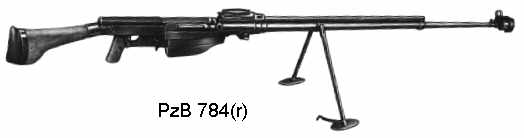
The PTRS-41 is a 14.5x115mm-firing anti-tank rifle used by the Soviet Armed Forces during World War II. It appears in Call of Duty as a mounted weapon and Call of Duty: World at War as a portable weapon.
The Sturmgewehr 44 (pronounced Sturm-guh-VIER), better known as either the STG-44 or the MP44, was a German assault rifle developed during World War II. It is featured in Call of Duty, Call of Duty: United Offensive, Call of Duty 2: Big Red One, Call of Duty 2, Call of Duty 3, Call of Duty 4: Modern Warfare, and Call of Duty: World at War. The STG-44 is widely considered to be the world's first true assault rifle.
The Samozaryadnaya Vintovka Tokareva, Obrazets 1940 goda (Tokarev Self-loading Rifle, Model of 1940, Russian: Самозарядная винтовка Токарева, образец 1940 года) is a Soviet semi-automatic battle rifle, which saw widespread service in World War II.
The Springfield M1903A4 was a sniper rifle used by the American soldiers during World War II, modified from the earlier versions of the Springfield M1903 which were used as regular battle rifles. After the Spanish American war, the M1903 was designed and replaced the Krag rifle as the standard rifle of American forces and was used in World War I. The M1903 was developed after the U.S. needed a rifle that could use higher loads and compete with Mauser weapons. Springfield Armory began to create a rifle with some of the Mauser's and Krag's features and eventually the M1903 was designed, after an unsuccessful first attempt. It was replaced with the M1 Garand in 1936, but for World War II, it was modified to the M1903A4, the sniper rifle variant, and was used by almost all American snipers. Early in the Pacific War, the USMC still used Springfields, but that was at a time when the USMC was not given the top procurement, being seen as a lesser branch of the US Navy.
Sten of the Sten Gun was a British 9 mm submachine gun used during World War II
The Tokarev TT-33 was developed by Fedor V. Tokarev. The first model, TT-30 of which only a few thousand copies were made, was modified and in 1933 the TT-33 came out. This new version was simpler to produce. The contraction TT-33 is for Tula Tokarev model 1933. The semiautomatic pistol developed by Tokarev 1933 was manufactured in Tula 150 km south of Moscow.
Used extensively through the armies of the British Commonwealth from 1939-1945, the Webley Mk IV revolver is a simple, no frills combat revolver. Firing a smaller 0.38-inch round than the World War I-era Webley 0.455-inch pistol, the Mk IV is lighter, easier to fire and requires less training and practice to use. The Mk IV is so popular it remains in service in various parts of the world to this day.
